

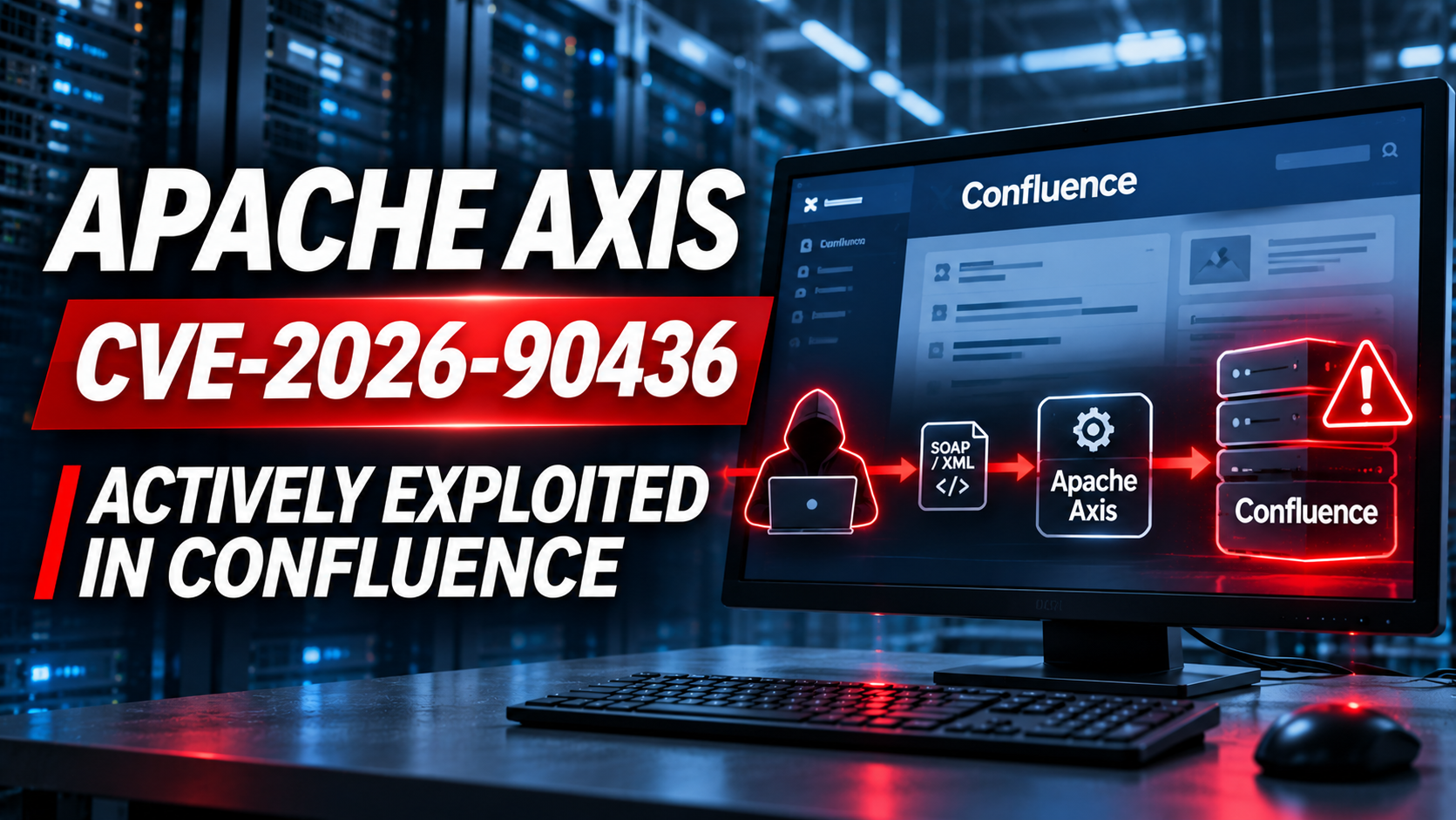
A critical remote code execution vulnerability in Apache Axis is being actively exploited against Atlassian Confluence Data Center and N-able N-central deployments, with attacks observed within days of a public proof-of-concept release and a Metasploit module now publicly available. The flaw, tracked as CVE-2026-90436 with a CVSS score of 9.8, was added to CISA’s Known Exploited Vulnerabilities catalog on November 18, 2026, requiring all federal civilian executive branch agencies to apply patches under a binding operational directive.
What Is CVE-2026-90436?
CVE-2026-90436 is an unsafe reflection flaw (CWE-470) in Apache Axis 1.x, a SOAP web services implementation for Java. The vulnerability allows an unauthenticated attacker to execute arbitrary code on affected systems by sending a crafted request to a SOAP endpoint. Apache Axis 1.x is end-of-life and will not receive a patched 1.x release; Apache recommends migrating to Axis 2 or another SOAP engine.
Atlassian Confluence Data Center versions 1.x through 9.x are affected when the Remote API (XML-RPC and SOAP) feature is enabled. Atlassian released a fix in version 9.2.28, and version 10.x removed the vulnerable feature entirely. N-able N-central is affected through its Legacy API feature, with version 2026.4 HF3 disabling the vulnerable component. Atlassian Cloud is not affected.
Active Exploitation Timeline
The vulnerability was disclosed by the Apache Software Foundation on November 6, 2026. A proof-of-concept targeting N-central appeared on November 12, and Rapid7 Managed Detection and Response detected exploitation against a Confluence Data Center customer on November 13 – the same day N-able reported active exploitation against N-central. A Metasploit exploit module for Confluence was released on November 17, lowering the bar for exploitation to any attacker with access to the framework.
What Attackers Are Doing
Rapid7’s incident analysis of an observed attack against a Confluence Data Center deployment found attackers sending unauthenticated requests to the SOAP endpoint and running shell commands as the Confluence service account using hex-encoded command sequences hosted on temporary tunnel domains. The observed intrusion included host and network enumeration, database credential extraction pulling page content, attachments, and files containing credentials and payment card numbers, and an attempt at AS-REP roasting against a domain controller. Approximately twelve hours into the observed intrusion, attackers used a compromised service account to sign into Microsoft 365 using legacy authentication.
Who Is Affected and What to Do
Organizations running Atlassian Confluence Data Center with the Remote API feature enabled and N-able N-central with the Legacy API feature active are at direct risk. Federal civilian agencies have until December 1, 2026 to apply patches under BOD 26-04. Recommended actions:
- Update Confluence Data Center to version 9.2.28 or later, or upgrade to version 10.x where the vulnerable feature has been removed.
- Update N-able N-central to version 2026.4 HF3 or later.
- Disable the Remote API (XML-RPC and SOAP) feature in Confluence if the update cannot be applied immediately.
- Review logs for unauthenticated requests to SOAP endpoints and for lateral movement indicators including M365 legacy authentication sign-ins from service accounts.
- Block public internet access to the Confluence Remote API endpoint at the network perimeter as a temporary mitigation.

Ventsislav Krastev
Ventsislav is a cybersecurity expert at SensorsTechForum since 2015. He has been researching, covering, helping victims with the latest malware infections plus testing and reviewing software and the newest tech developments. Having graduated Marketing as well, Ventsislav also has passion for learning new shifts and innovations in cybersecurity that become game changers. After studying Value Chain Management, Network Administration and Computer Administration of System Applications, he found his true calling within the cybersecrurity industry and is a strong believer in the education of every user towards online safety and security.
Follow Me: