

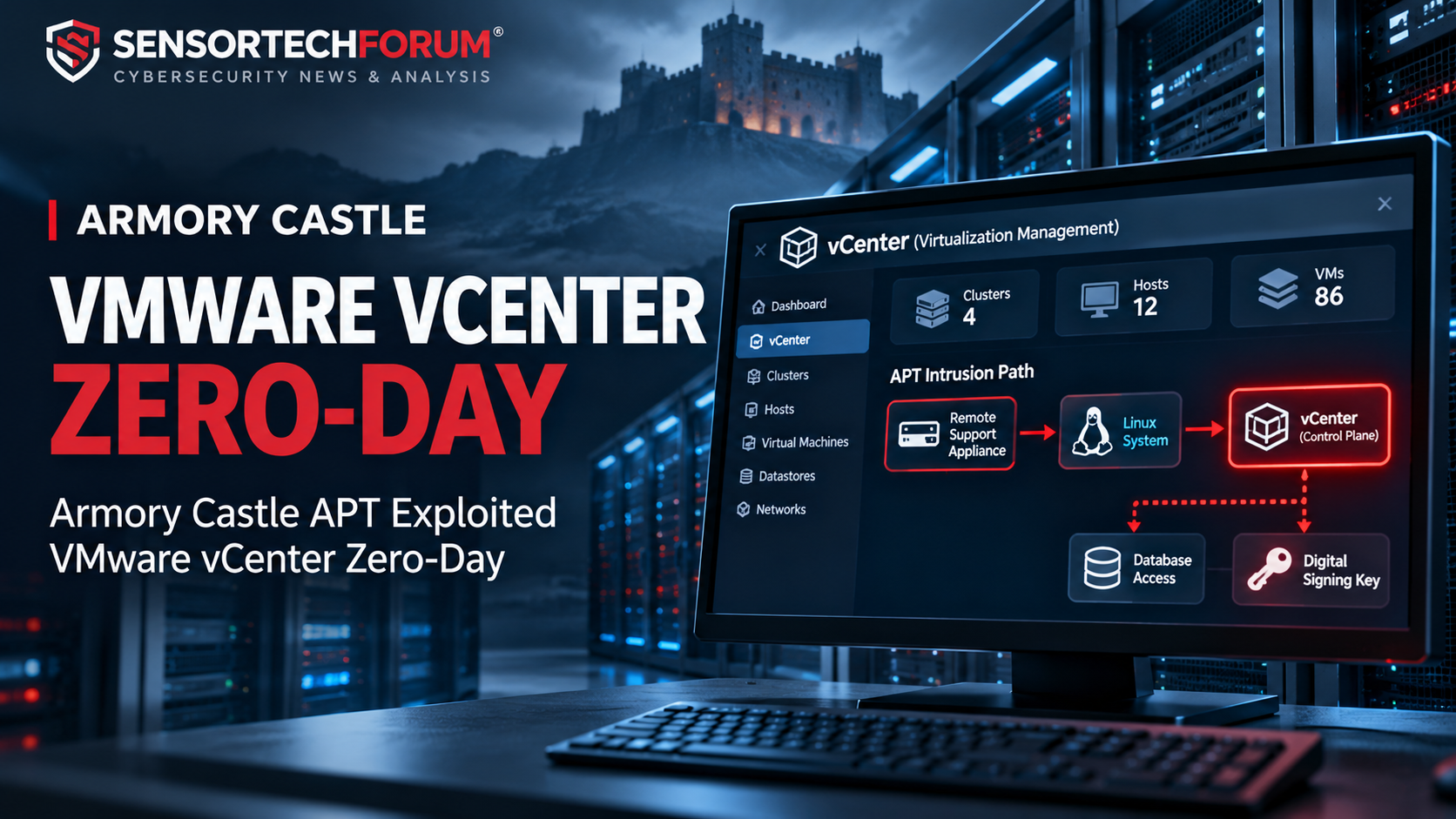
A China-nexus cyber espionage group tracked as Armory Castle exploited a critical authentication bypass zero-day in VMware vCenter Server beginning in early September 2026, achieving full administrative control of targeted virtualized environments, stealing data, and establishing multiple persistence backdoors before patches were released on November 19, 2026. The vulnerability, CVE-2026-123890, carries a CVSS score of 9.8 and was discovered and reported by Google Threat Intelligence Group and Mandiant.
What Is CVE-2026-123890?
CVE-2026-123890 is an unauthenticated session key disclosure vulnerability in the VMware Directory Service (vmdird) in vCenter Server. It operates over Distributed Computing Environment/Remote Procedure Calls (DCE/RPC) and allows an unauthenticated attacker to disclose the Secure Remote Password (SRP-6a) session key, bypassing authentication and gaining administrator-level access to vCenter. The flaw is distinct from CVE-2026-59309, a vCenter logging flaw that Armory Castle also exploited this year to reduce audit visibility during intrusions.
What Armory Castle Did
Google and Mandiant’s analysis documents a multi-stage intrusion sequence following successful CVE-2026-123890 exploitation:
- Gained administrator session on vCenter through the authentication bypass.
- Stole the LMDB database (data.mdb) containing vCenter configuration and credential data.
- Hijacked the SAML Security Token Service and created a new SSO administrator account for persistent privileged access.
- Enabled SSH on targeted servers via the VAMI API and added an SSH key to the ESXi root account.
- Archived and exfiltrated ESXi data.
The same campaign used CVE-2026-102764, a critical zero-day in BeyondTrust Remote Support (CVSS 9.3), as the initial entry point for some intrusions.
What Administrators Should Do
Broadcom released patches for CVE-2026-123890 on November 19, 2026. Organizations running VMware vCenter Server should:
- Apply the November 19 patches immediately.
- Review vCenter and ESXi audit logs for unauthorized administrator account creation, SSH key additions, VAMI API activity, and SAML STS modifications going back to at least early September 2026.
- Check for unexpected service accounts in SSO administrator groups.
- Restrict network access to vCenter management interfaces to authorized management hosts only.
- Review BeyondTrust Remote Support deployments for CVE-2026-102764 exposure.

Ventsislav Krastev
Ventsislav is a cybersecurity expert at SensorsTechForum since 2015. He has been researching, covering, helping victims with the latest malware infections plus testing and reviewing software and the newest tech developments. Having graduated Marketing as well, Ventsislav also has passion for learning new shifts and innovations in cybersecurity that become game changers. After studying Value Chain Management, Network Administration and Computer Administration of System Applications, he found his true calling within the cybersecrurity industry and is a strong believer in the education of every user towards online safety and security.
Follow Me: